
Pre-Order Now
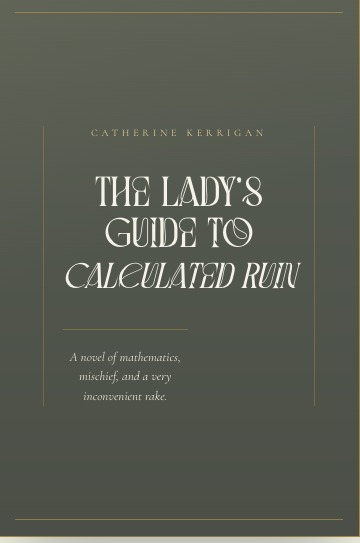
The Lady's Guide toCalculated Ruin
A Regency heroine who runs a discreet problem-solving salon, a rake with inconvenient intelligence, and a contract every woman in the ton wishes she had written first.
- Publication
- June 29
- Release Year
- 2027
- In Series
- #1
The Story
A ledger kept by a woman is never just accounts
Theodora Thornbury operates from a back parlor in Mayfair, where a painted sign—discreet, easily missed—reads Consultations by Appointment. Her clients come with the sort of trouble that cannot be spoken of in polite company: indiscreet letters, inconvenient entanglements, the occasional inheritance gone peculiarly sideways. Theodora handles all of it. She has been doing so for four years without scandal, without assistance, and without any particular desire to change either condition.
Robert Ashford, Earl of Briarcliffe, is not her usual client. He is too well-connected, too self-possessed, and entirely too aware of what he is asking when he sits down across from her and explains, in the most economical of terms, what he needs. His problem is not the kind Theodora normally touches. It involves a forgery, a dead man whose reputation needs protecting, and a set of letters that—if read by the wrong party—would ruin three families and embarrass the government.
Theodora takes the case. She is not certain why. The Earl offers a good fee, but that is not the reason. He has an interesting mind—she is reasonably sure that is not the reason either. She opens her ledger. She has a policy about working with rakes. Not a prohibition. A caution. She takes the case anyway, and writes his name in the column she keeps for complications.
Order Your Copy
Available for pre-order
Order from your preferred retailer. Pre-ordering tells the publisher the book matters.
Store links appear here as each retailer lists the book. Until then, the sign-up below is the surest way to hear.
Support your local independent bookshop—ask them to order a copy even if it isn't listed above.
First Chapter Excerpt
Chapter One
The appointment card said half past two. It was now a quarter to three, which Theodora Thornbury noted without displeasure—she had learned to distinguish between the lateness of a man who wished to establish advantage and the lateness of a man who was genuinely uncertain whether to come at all. The Earl of Briarcliffe, from what little she had been able to determine in the forty-eight hours since his card arrived, was probably the second kind.
She was reviewing her ledger when Mossop showed him in. She did not close the book.
He managed her name with deliberate understatement. “Miss Thornbury.” Not the Miss Thornbury, not the theatrical pause that some of her clients could not resist. Simply her name, plainly spoken, as though he were not standing in a room most of his acquaintance would have found difficult to explain.
“Lord Briarcliffe.” She gestured to the chair. “You have the inconvenient kind, I take it.”
He settled himself with the unhurried ease of a man accustomed to rooms arranging themselves around him. “I beg your pardon?”
“Of problem,” she said. “There are two kinds. The kind a person knows they have, and the kind a person suspects they have but cannot yet prove. You have been sitting in that chair for thirty seconds and you have already looked at my ledger, the card index, and the mechanism on the corner of my desk. You are trying to determine whether I am competent. That suggests you already know the answer will matter.”
The Earl of Briarcliffe looked at her for a moment with something she might have called respect, if she had been less careful with her assessments. “You have better arithmetic than reputation,” he said.
“My reputation is managed by other people.” She opened her ledger to a fresh page, uncapped her pen, and wrote the date at the top in her small, even hand. “I have a policy about rakes, Lord Briarcliffe. Not a prohibition—I am not sentimental about categories—but a caution. The kind of trouble that follows a man of your particular history tends to require a great deal of ancillary work that does not appear in the original estimate.” She looked up. “Tell me about the letters.”
He told her. It took the better part of twenty minutes. She did not interrupt. When he finished, she set down her pen, regarded what she had written, and allowed herself one moment to consider whether she wished to be sensible. She wrote his name at the top of the page. She had a column in this ledger that she kept for complications. She wrote it there instead.
Continue reading when the book publishes June 29, 2027.
Be first to know
Cover reveals, release dates, and news as it happens—in the newsletter.